
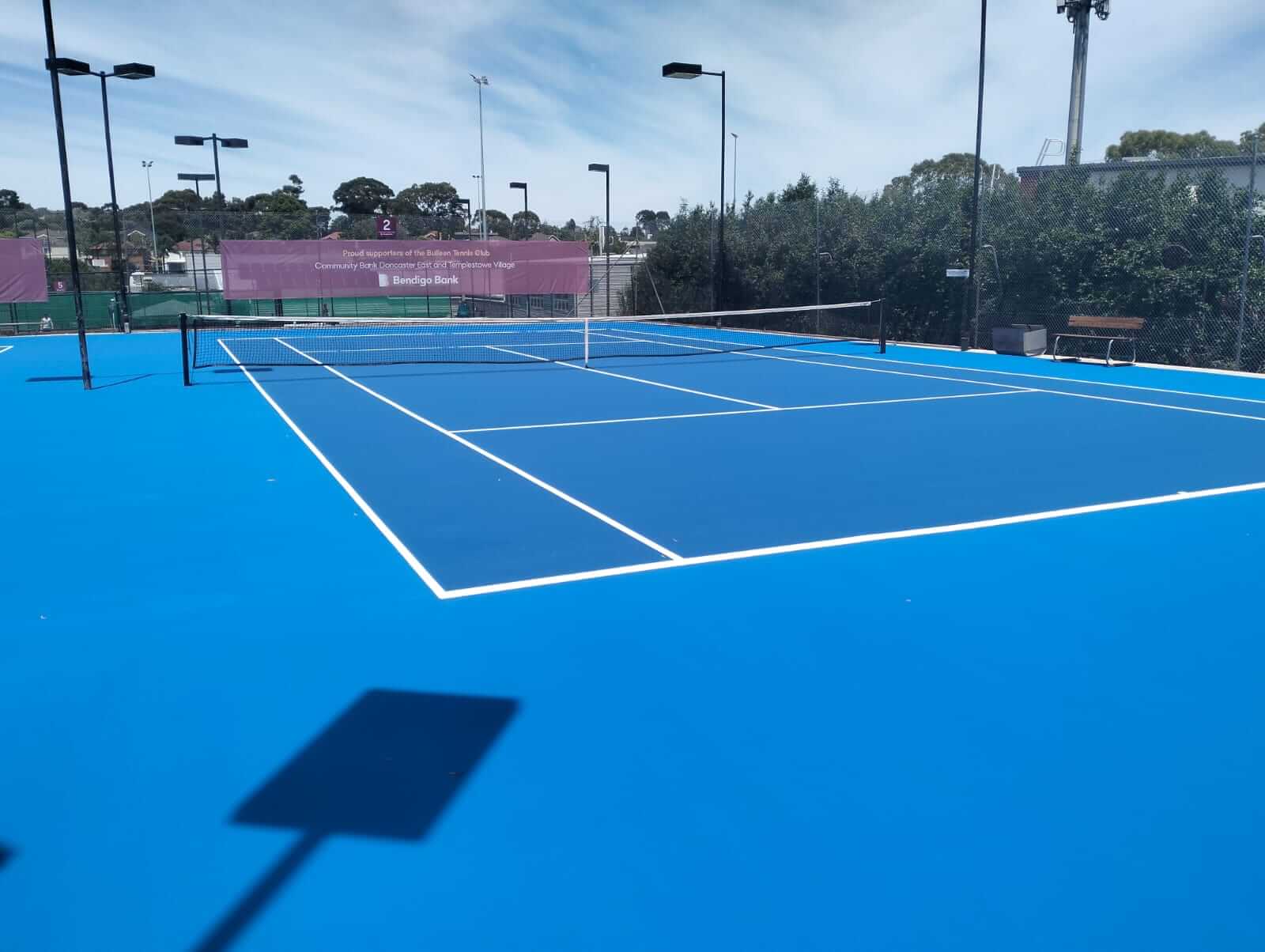
Ash & El explains tennis court resurfacing in Melbourne, including when cracks, worn coatings, faded lines or drainage need assessment.
Tennis court resurfacing in Melbourne may be appropriate when widespread coating wear, poor traction or faded markings affect play. However, resurfacing is not an automatic fix for every crack, uneven area or drainage problem, so the existing court should be assessed before work is scoped.
When Should a Tennis Court Be Assessed?
Arrange an assessment when defects extend beyond routine cleaning or isolated maintenance. A single stain or minor surface issue may not justify resurfacing, while recurring cracks, peeling coatings and widespread wear can indicate that broader work should be considered.
Warning signs include:
- Visible cracking: Record where cracks occur, whether they are widening and if earlier repairs have failed.
- Standing water: Water remaining after rain may indicate low areas, blocked drainage or another issue requiring investigation.
- Slippery sections: Algae, contamination or loss of surface texture can reduce traction, particularly in shaded or damp areas.
- Faded line marking: Lines that are difficult to distinguish can interfere with play and make the court look poorly maintained.
- Worn high-use zones: Baselines and other frequently used areas may deteriorate faster than the rest of the court.
- Peeling or loose coatings: A coating separating from the underlying surface requires assessment before another layer is applied.
- Repeated patching: Recurring repairs can indicate that the cause has not been resolved.
Maintenance, Repair or Full Resurfacing?
Cleaning may be enough where dirt, organic growth or surface contamination is the main problem, and the coating remains sound. Isolated defects may be repairable, but you must consider compatibility with the existing surface and the likelihood of the defect returning.
Resurfacing becomes more relevant when deterioration affects substantial areas or when the existing coating and line marking require renewal. Our existing guide to professional sports court resurfacing identifies cleaning, crack repairs, acrylic coating and line marking as potential parts of the process for relevant tennis courts.
Those steps are not a fixed scope for every project. Significant movement, unstable substrates, persistent drainage problems or extensive unevenness may require work outside routine resurfacing. An inspection should establish what can reasonably be addressed and what must be excluded or referred for separate assessment.
Tennis Court Resurfacing in Melbourne Depends on the Site
Court condition depends on usage, surface type, exposure, maintenance history and previous repairs—not age alone. The Tennis Victoria Acrylic Court Maintenance Guide recommends checking drainage, cracks, line markings, contamination and slippery areas. However, this guidance applies specifically to acrylic courts, not all surface types.
Before requesting a quote, provide:
- the court location and approximate dimensions;
- the known surface type and age;
- photographs of cracks, peeling and worn areas;
- details of water pooling or drainage concerns;
- previous resurfacing and repair history;
- required sports and line-marking layout; and
- site access, fencing and operating restrictions.
Our broader fencing, landscaping and sports court services may also be relevant where the project includes surrounding access or fencing. These elements should be scoped separately instead of assumed to form part of resurfacing.
Arrange a Professional Court Surface Assessment Today
Resurfacing should follow a site-specific review, not a generic replacement interval. The right next step may be cleaning, targeted repairs, resurfacing or investigation of a deeper surface or drainage issue.
Ash & El provides sports court resurfacing services across Melbourne, Warragul, Gippsland and other Victorian suburbs. Get in touch with us to discuss your court location, surface details, photographs, known defects, and to request an assessment and project quote.